The Capsule Apartment: A Minimalist’s Guide to Sustainable Small-Space Living
December 1, 2025 • Hyper-Efficient Design & Tiny Living
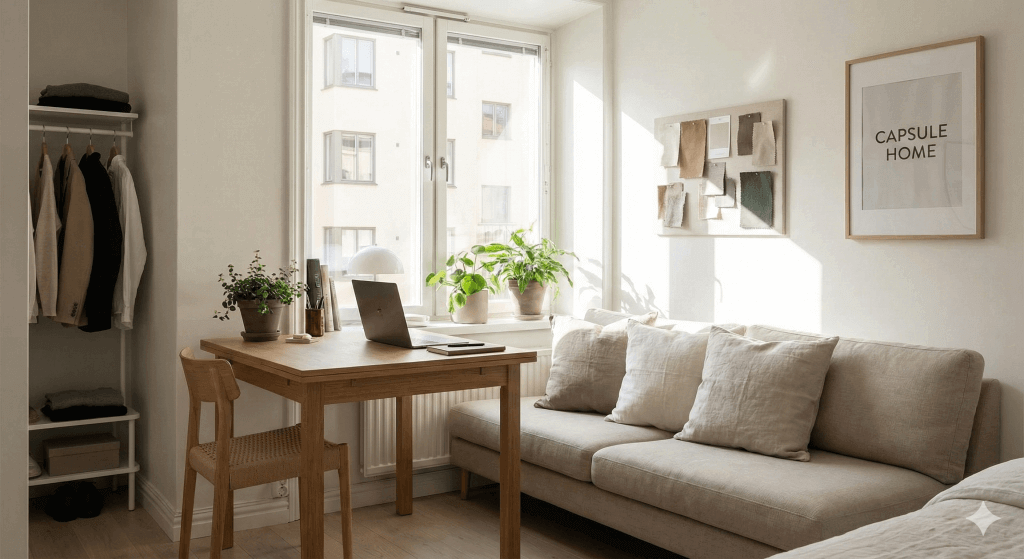
Most of us are familiar with the concept of the Capsule Wardrobe.
Popularized by minimalists like Courtney Carver (Project 333), the idea is simple: pare down your closet to a small collection of high-quality, versatile items that all match one another. It eliminates decision fatigue, saves money, and drastically reduces textile waste.
But while we are busy curating our closets, many of us return home to living rooms that tell a different story. We are surrounded by impulse buys, “Fast Furniture” that is already wobbling, and items that serve only one purpose and take up precious square footage.
If you live in a small apartment or an urban eco-space, you don’t have the luxury of waste—wasted space, wasted money, or wasted materials.
It is time to take the logic of the wardrobe and apply it to our homes. Welcome to the era of the Capsule Apartment.
What is a Capsule Apartment?
A Capsule Apartment is a curated approach to interior design where every item in your home is intentional, high-quality, and serves multiple purposes.
Just as a capsule wardrobe focuses on a few pairs of great jeans rather than ten pairs of cheap ones, a capsule home focuses on “Slow Furniture.” It rejects the trend cycle. It isn’t about having an empty, sterile white box; it is about having a home where every single object earns its rent.
The Problem with “Fast Furniture”
To understand why the Capsule Apartment is necessary, we have to talk about the villain of this story: Fast Furniture.
Much like Fast Fashion, Fast Furniture is mass-produced, inexpensive, and designed to be disposable. It is usually made from particle board, held together by toxic glues, and covered in synthetic veneers that cannot be repaired. According to the EPA, Americans throw out over 12 million tons of furniture and furnishings every year. Most of it ends up in landfills because the mixed materials make it nearly impossible to recycle.
The Capsule Apartment is the antidote. It prioritizes:
- Versatility: Can this item be used in the bedroom and the living room?
- Longevity: Will this last for 20 years? Can it be repaired?
- Sustainability: Is it made of natural, renewable materials?
Phase 1: The Audit (Shop Your Home First)
Before you buy a single sustainable chair or eco-friendly rug, you must audit what you already have. The most sustainable item is the one you already own.
To begin your capsule journey, look at the furniture in your main living space and apply the “stranger test.” If a stranger walked into your apartment, would they know exactly what that room is for, or would they be confused by the clutter?
Ask these three questions for every major piece of furniture:
- Is it working? Not just “is it broken,” but does it function for your life? (e.g., Do you have a massive dining table but always eat on the couch?)
- Is it versatile? If you moved to a new apartment tomorrow with a different layout, could this piece still fit?
- Does it bring you peace? In a small space, your eye lands on everything. If an item annoys you, it is essentially a roommate you don’t like.
The “Re-Home” Responsibility
If you decide an item doesn’t fit your capsule, do not throw it in the dumpster. As an eco-conscious citizen, use:
- Buy Nothing Groups: These hyper-local Facebook groups are gold mines for re-homing items.
- Donation Centers: Habitat for Humanity ReStore is excellent for furniture.
- Upcycling: Can that wobbly particle-board bookshelf be laid horizontally and turned into a shoe rack inside a closet?
Phase 2: The Rule of Three (Versatility)
In a capsule wardrobe, a shirt must work for work, the weekend, and dinner out. In a Capsule Apartment, we use the Rule of Three.
The Rule: Any large item introduced into a small space should ideally serve three potential functions or fit in three different rooms.
When you live in 400–800 square feet, specialization is the enemy. Here is what the Rule of Three looks like in practice:
The Hero Piece: The Stool
The humble stool is the MVP of the Capsule Apartment.
- Function 1: Extra seating when guests come over.
- Function 2: A side table for your coffee or book.
- Function 3: A plant stand to catch the morning sun.
- What to look for: Solid wood or metal with a flat top. Avoid contoured seats if you want to use it as a table.
The Hero Piece: The Dining Table
If you have space for a table, it needs to work hard.
- Function 1: Dining.
- Function 2: Work-from-home desk.
- Function 3: Food prep island (vital for small kitchens with no counter space).
- What to look for: A surface that can handle heat and scratches (solid wood or stone). Avoid glass (hard to work on with a mouse) or delicate veneers.
The Hero Piece: The Daybed / Sleeper
- Function 1: The primary sofa.
- Function 2: The guest bed.
- Function 3: Hidden storage (if you choose a model with a lift-up seat).
Expert Tip: Avoid “uni-taskers.” A dedicated media console that only holds a TV is a waste of space. Instead, use a dresser. It holds the TV, but the drawers hold clothes, linens, or paperwork.
Phase 3: Materiality and “Slow Furniture”
This is where the “Eco” in SmallEcoSpace comes into play. To build a capsule home, you need items that age with you, not against you.
Wood: Solid vs. Veneer
In a capsule home, we prioritize solid wood.
- Why? If you scratch a solid oak table, you can sand it down and re-oil it. It develops a “patina”—a gloss produced by age and polishing.
- The Alternative: If you scratch a cheap veneer table, you expose the particle board underneath. It absorbs moisture, swells, and is ruined.
- Eco-Check: Look for FSC-Certified wood (Forest Stewardship Council) or, even better, reclaimed wood.
Textiles: Natural vs. Synthetic
- Linen and Cotton: These are breathable, biodegradable, and washable. A 100% linen sofa cover can be thrown in the wash.
- Polyester/Microfiber: These shed microplastics into the water system every time you wash them. They also tend to pill and trap odors over time.
Metal: The Forever Material
Powder-coated steel or aluminum is fantastic for small spaces. It is visually light (taking up less visual weight than chunky wood) and is endlessly recyclable. A vintage metal chair from the 1950s is likely as sturdy today as the day it was made.
Phase 4: Visual Cohesion (The “Base Layer”)
How do you make a capsule apartment feel like a home and not a furniture showroom? You create a cohesive Base Layer.
In fashion, this is your neutrals—your black pants, white tees, denim jackets. In your home, these are your walls, your floor coverings, and your large furniture pieces.
The Palette Strategy
For small spaces, keep your “Base Layer” neutral. This doesn’t mean boring; it means flexible.
- Warm Neutrals: Cream, beige, terracotta, oatmeal.
- Cool Neutrals: Grey, slate, white, sage green.
By keeping your sofa, rug, and curtains in the same color family, you blur the lines of the room, making the space feel larger.
Texture > Pattern
A common mistake in small spaces is trying to add personality through loud patterns (a chevron rug, floral curtains). This creates visual noise that makes the walls feel like they are closing in.
Instead, use texture. Pair a smooth leather chair with a chunky knit wool throw and a rough jute rug. You have created complexity and warmth without visual clutter. This is the secret to that “expensive minimalist” look—it’s all about the mix of materials.
Phase 5: Accessorizing Without Cluttering
The Capsule Apartment allows for personality, but it requires discipline. Use the “Container Method” for decor.
Designate specific areas for decor—a single shelf, the coffee table tray, the windowsill. You can fill these containers, but you cannot overflow them.
The Seasonal Rotation
Just as you swap your winter coat for a summer jacket, swap your decor.
- Winter: heavy wool throw, darker pillow covers, dried flowers.
- Summer: linen throw, bright pillow covers, fresh clippings.
Store the off-season items in a single box. This keeps your home feeling fresh and dynamic without buying new things constantly.
Plants: The Ultimate Sustainable Decor
If you feel your space looks too sterile, add a plant. Plants are the only decor that actively contributes to your health by filtering air. They add a pop of “living color” that matches any aesthetic.
How to Afford the Capsule Apartment
You might be thinking, “Solid wood? Linen? This sounds expensive.”
If you buy everything brand new from high-end sustainable boutiques, yes, it is expensive. But that isn’t the SmallEcoSpace way.
1. Buy Vintage: The most sustainable furniture is furniture that already exists. Vintage solid wood furniture is often cheaper than new particle board furniture. Scour Facebook Marketplace, estate sales, and antique malls.
2. Cost Per Use (CPU): Do the math.
- The Cheap Chair: Costs $100. Breaks in 2 years. CPU = $50/year.
- The Capsule Chair: Costs $400. Lasts 20 years. CPU = $20/year.
The capsule approach is an investment in your future financial freedom.
Conclusion: Start Small
Transforming your home into a Capsule Apartment isn’t a weekend project. It is a slow, intentional shift in mindset. It is about stopping the influx of “stuff” and starting to curate a space that supports your life.
Your Next Step: Do not go out and buy anything. Instead, identify the “imposters” in your home. Find one item of furniture that is broken, frustrating, or serves only one purpose. Make a plan to repair it, upcycle it, or re-home it.
Clear the space. Live with the empty spot for a week. You might find that the best addition to your small eco space is simply… space.
About the Author
SmallEcoSpace is dedicated to helping urban dwellers live big with a small footprint. We believe that sustainability starts at home, no matter how many square feet you have.